A Taste of the Sea
John Wright Restaurant
Lancaster may be landlocked (it’s one of the oldest inland cities in the United States), but its residents love fresh seafood. Crabs from the Chesapeake Bay, oysters from Chincoteague, shrimp from the Gulf Coast and fresh-caught tuna and other saltwater fish from the Eastern Seaboard are the specialty of John Wright Restaurant, which sits on the western shore of the Susquehanna River.

Housed in a 27,000-square-foot brick building constructed in 1916 as a warehouse for the Wilton foundry, it was later used as a silk mill from 1932 until the early 1960s. The restaurant grew out of a sandwich shop that served patrons of the John Wright Factory Store, which had moved to the warehouse. Today, it’s a multifaceted restaurant that serves lunch, dinner and Sunday Brunch, hosts weddings and other special events and takes full advantage of the spectacular riverfront setting that attracts wildlife such as eagles, peregrine falcons, ospreys and blue herons.
Guests can choose from two dining areas. The Four Seasons dining area, which is housed in a climate-controlled, glass-enclosed timber-frame structure, offers an adventurous menu and a gorgeous view of the Susquehanna and Veterans Memorial Bridge. The Pizza Patio, a portion of which is covered, has its own bar, kitchen and menu that features salads, burgers and sandwiches, kabobs and an array of 10-inch, wood-fired pizzas. The Pizza Patio is open June through August.
“We really have two restaurants with the Four Seasons Room and the patio. With the warm weather, the Pizza Patio comes alive and has its own vibe,” says Jim Switzenberg, the restaurant’s director of operations and executive chef. A graduate of the Culinary Institute of America, he managed restaurants in New York City, Houston and Los Angeles, and served as senior instructor for HACC’s culinary program prior to coming onboard at John Wright to oversee the restaurant’s expansion in 2011.
John Wright’s focus is on local from both a décor and menu standpoint. For example, the barstools, dining tables and outdoor bars were made by a local craftsman who used wood salvaged from fallen trees to create them. The wine cellar was crafted across the street at Donsco, which is North America’s leading single-source provider of machined iron casting.

As for the menu, “We are all about local and non-GMO products. We work with local farmers to source produce, meat and dairy products,” Jim says. Local ingredients include produce from Lehman’s Roadside Market, Wrightsville; brown eggs from the King Fisher Farm, Elizabethtown; raw goat Feta from Breezy Meadows Farm, Myerstown; honey from Gingrich Apiaries, Dover; sustainably grown lettuces and herbs from Brogue Hydroponics, Brogue; year-round blueberries from Blueberry Hill, Red Lion; nut butters from Blind Spot Nut Butters, York; and maple syrup from Shuey Maple Syrup, Westfield. In-season blackberries and heirloom tomatoes are provided by Ironwood Farm, Millersville. Even flour is purchased from a mill in the region – Castle Valley Mill in Doylestown. Chicken is sourced from Bell & Evans, Fredericksburg; and wagyu beef from Star Rock Farms, Conestoga. Jim forages for ramps each spring and utilizes the fruit of the pawpaw trees that grow on the premises. Ahead of a recent 18th century-themed dinner, he planned to harvest dandelion greens.
Jim reports that John Wright’s chefs, Zack Byers and Austin Hallet, curate the menu and specials using such ingredients. “Although there are menu staples, we work with our purveyors to create menu additions. Last year we added blue potatoes to the menu since one of our purveyors added that to the vegetables they grew. Our local purveyors are our partners,” he explains. Local ingredients are even used by pastry chef Nichole Flaharty to make ice cream, one of which is sweet corn. “It’s a great flavor, and it’s popular with our guests,” Jim notes.
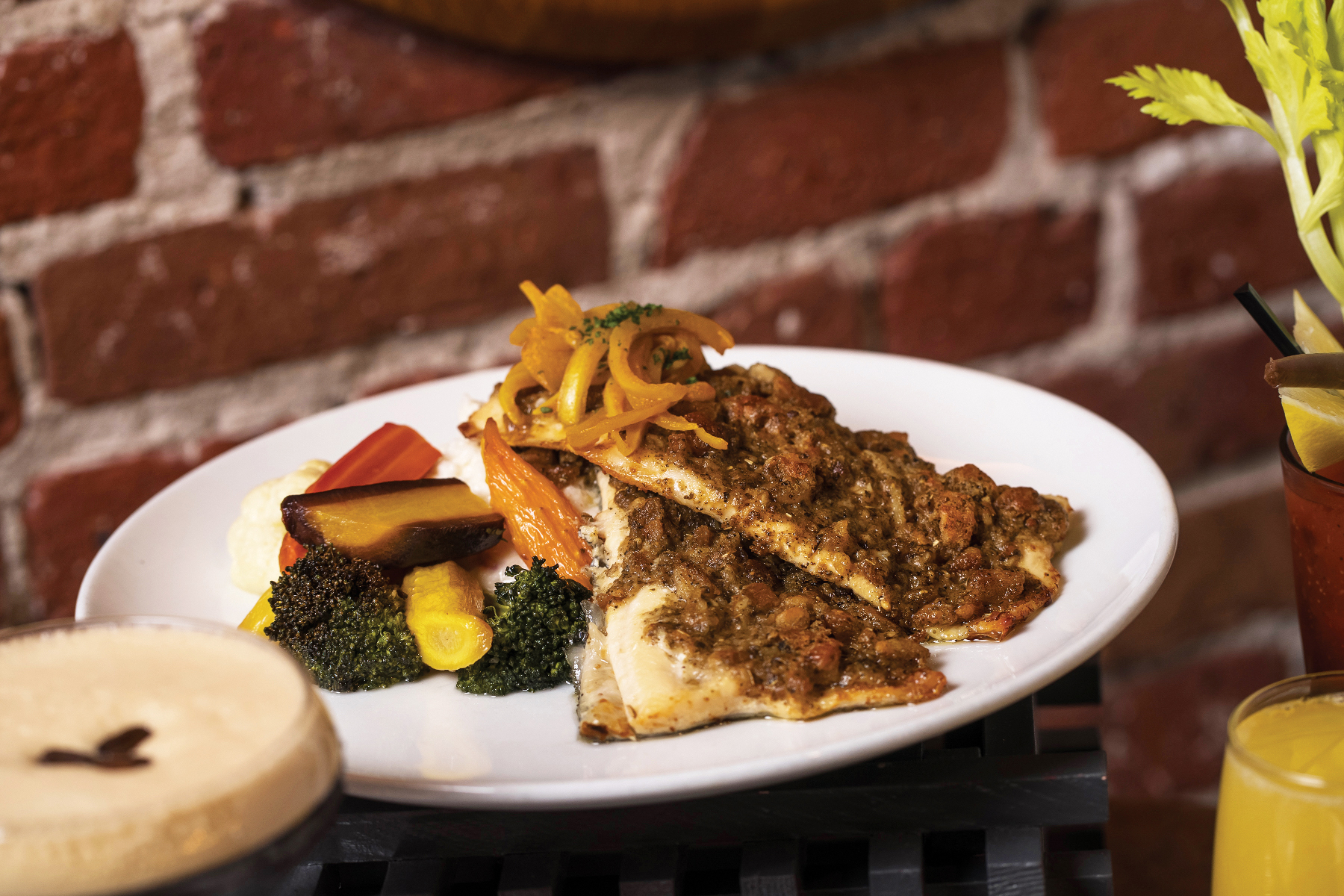
John Wright Restaurant’s menu also emphasizes fresh seafood. Jim traces his love for fish to childhood. “I grew up surf fishing in Rehoboth Beach,” he says. “By the time I was 6 or 7, I was not only catching fish, but also cleaning, cutting and filleting them.” As a student at the Culinary Institute of America, Jim found himself perfecting his skills and learning more about the fishing industry. Working in restaurants with seafood programs furthered his knowledge and skills.
“We prefer to buy a whole fish and cut it ourselves,” he explains. “You can look at a whole fish and know how fresh it is,” he says of indicators such as the eyes and gills. Whole fish also provide his staff with hands-on experience. “We have a teaching kitchen,” he says of the educational opportunities that are afforded to the staff. We want our staff to go farther in their careers.”

John Wright partners with John Gross & Co., Mechanicsburg, to source fresh fish. “We have a whole network of fishermen, processors and buyers,” Jim explains. Technology has not only made the process easier but also fun. “It’s been great getting to know everyone and follow them on Facebook,” he says. As soon as someone catches something they think Jim might like, a photo is sent to his phone, and he responds instantly. Whether the catch is made off the Florida Keys, the Outer Banks or coastal Virginia, it can arrive at John Wright in a matter of two days. As a result, John Wright features a seafood-heavy menu that includes the freshest salmon, tuna, grouper and other selections. That philosophy carries over to Jim’s life outside the restaurant. “My wife is a pescatarian. I live in a fish-based home,” he reports.
John Wright’s bar also focuses on local brews and wines. The taps feature a rotating selection of Pennsylvania craft beer. (There’s also a selection of domestic and imported beer.) Spirits are also from local distillers including Stoll & Wolfe Distillery in Lititz. Wine selections include local vintners Finca de Torres and Allegro Winery, both in York County.
The restaurant also hosts a number of special events throughout the year including monthly themed dinners that feature cocktails paired with food items.
234 North Front Street, Wrightsville (York County)
Lunch: Wednesday-Saturday, 11 a.m.-3 p.m. Dinner: Wednesday and Thursday, 4-8 p.m., and Friday and Saturday, 4-9 p.m. Sunday Brunch Buffet: 11 a.m.-3 p.m. Pizza Patio (June-August): Wednesday-Sunday, 4-9 p.m.
Information: Jwrpa.com
Historical Tidbits
Humans have been eating fish for nearly 2 million years, making it one of mankind’s oldest dietary staples. Evidence of that, including fish bones and crude fishing hooks, has been found throughout the world. Egyptian burial tombs, for example, relate to fishing through art and preserved fish.
Fish from rivers and seas were smoked, dried and salted for trade purposes. The Greeks and Romans utilized nets and spears to fish.
The word “shrimp” is derived from the English “shrimpe” (or pygmy).
Seafood also entails its own luxury brand, lobster. At one time lobster was so plentiful that piles of them could be found on beaches around Plymouth, Massachusetts. In fact, in 1622, Governor William Bradford apologized to newcomers that all he could offer them was “lobster and a cuppe of fair water.”
Fast forward a few centuries to New York, where a sea captain named Ben Wenberg was a regular at the restaurant Delmonico’s. During one return trip from the Caribbean, Wenberg shared a new way to cook lobster that involved a chafing dish with the restaurant’s owner, Charles Delmonico. He loved it and added it to the menu, naming it Lobster Wenberg. As the story goes, the two had a falling out and Delmonico removed the dish from the menu. Repeated requests for Lobster Wenberg prompted its return but with a new name. Delmonico switched the w and n, hence Lobster Newberg.