Classic American Steakhouse
401 Prime
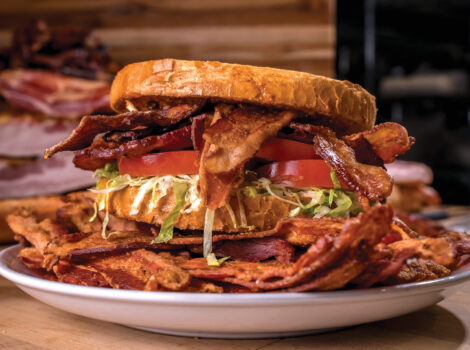
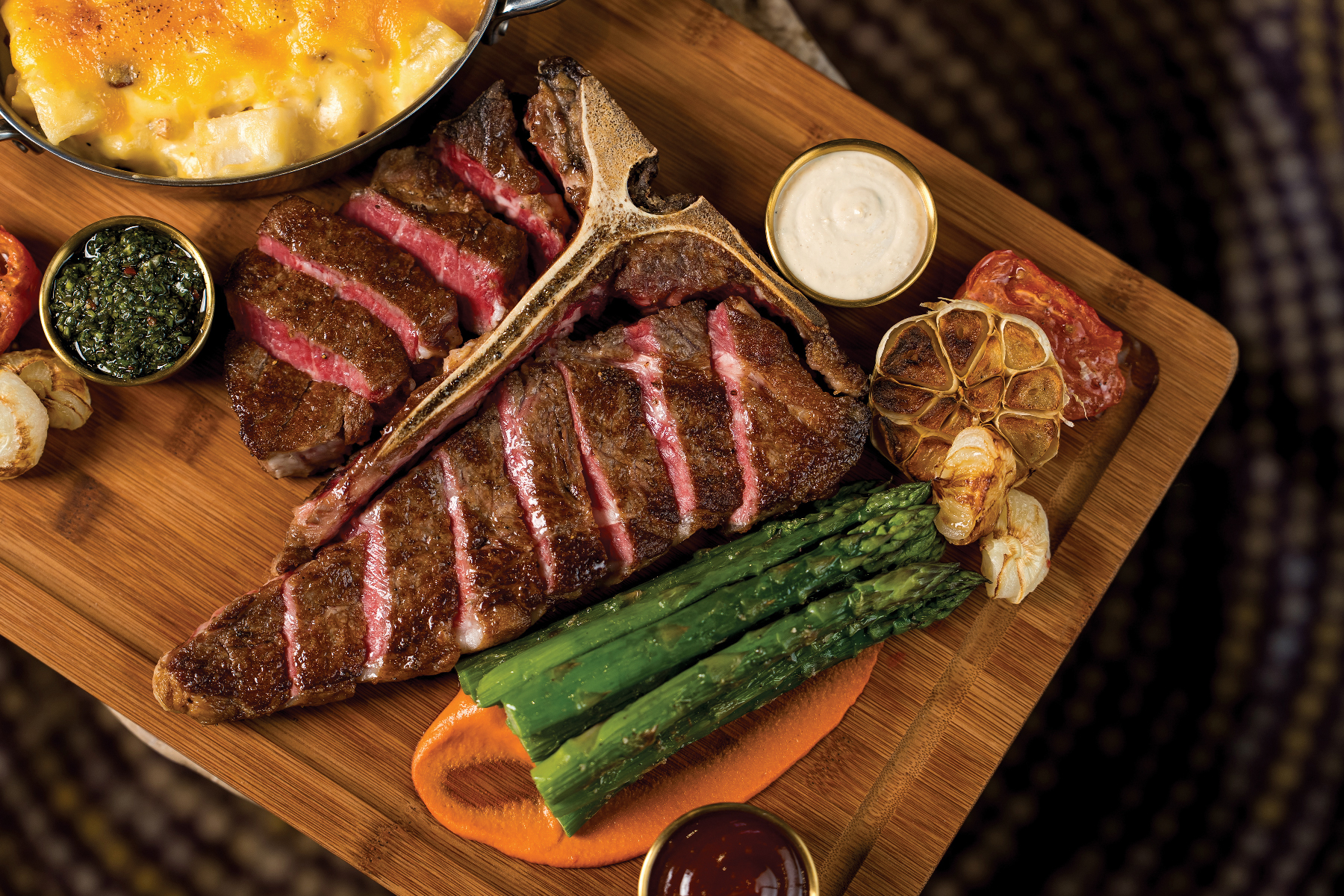
Sink into a velvet banquette and place your order for a thick steak or a juicy burger with all the trimmings. Pair it with a bottle of full-bodied red wine, a vintage cocktail or a glass of bubbly and you’re in heaven … or the next best thing, 401 Prime.

Three years ago, when the Vescor Hospitality Group was presented with the opportunity to take over one of the most beautiful dining spaces in Lancaster, they didn’t hesitate to do so. Unlike many instances, this one was turnkey. Outside of a few behind-the-scenes issues, the restaurant was ready to welcome guests. That left the team – now consisting of Dean Oberholtzer, Justin Ang and John Costanzo – with the time and creative energy to fashion a name and design a concept for the restaurant.
As for the name, 401 alludes to the address (401 North Prince Street), while Prime refers to the culinary focus of the restaurant – steaks, notably wagyu.
The idea of transforming the restaurant into an upscale, classic American steakhouse appealed to the partners. “Lancaster has not had a classic steakhouse in quite a while,” notes Justin. Another point in their favor was the fact that beef had staged a strong comeback thanks in part to the public’s appetite for wagyu beef and gourmet burgers. All one had to do was look at the popularity of upscale steakhouses in cities such as New York, Philadelphia and Washington for verification.

“We knew we’d be pushing the envelope, but we thought it was time to reintroduce the concept here,” Justin says. The gamble has proven to be a winner. “It’s gone over extremely well,” he shares. “There’s nothing quite like it in Lancaster. It’s glam, it’s clubby, guests love it.” It’s become the place to celebrate a special occasion or take part in special events such as a Kentucky Derby watch party or the recent Wagyu and Whiskey dinner.
Peruse sites such as Open Table and others and reviewers use words such as chic, cool, opulent, beautiful and the list goes on to describe the ambiance. The décor 401 Prime inherited – dark wood, rich, saturated colors, metallics and mood-setting lighting – perfectly lent itself to the steakhouse concept. “We did not have to make any changes,” Justin says. “It was a perfect fit for a steakhouse.”
One architectural change that was made saw a large chef’s table area in the kitchen be reconfigured into a glass-enclosed dining room that is used for private dinners, etc. “Our private dining areas are great for rehearsal dinners, celebrations of any kind or small company gatherings,” Justin points out.
The team also gained an asset in the large lounge/bar that has gained a reputation for hosting Lancaster’s best Happy Hour. Its menu is also in keeping with the steakhouse theme but on a small-plate scale.
The 401 Prime experience begins with the menu. Guests are always touched to find that congratulatory messages for birthdays, anniversaries, etc. are noted on their menus (which they can take home as a memento). Lavender-scented linens are provided. Lounge music floats through the dining rooms. The waitstaff is knowledgeable about the nuances of the menu.

The menu is a tour de force of culinary delights. Executive chef Colin Purtell, who hails from Baltimore, oversees the kitchen. Appetizers include Triple Cut Miso Bacon, Prime Beef Tartar and Short Rib Flat Bread. Soups include Prime Chili and Lobster Bisque. A Wasabi Salad is on the menu.
Seafood lovers will appreciate the king salmon, seabass, crabcakes and lobster dishes. Chicken, lamb and pork also are found on the menu. Even vegans are welcomed with dishes such as Vegan Filet (made with seitan and beets) and General Tso’s Sunchoke.
As for beef, the wagyu is from Japan’s Satsuma, Kobe region. “A5 Wagyu beef is the highest grade of beef. It’s something you can’t find everywhere,” Justin says of the high-end Japanese beef that is served at 401 Prime. It’s available as steak or in preparations such as meatloaf and burgers. Other beef-focused selections include filet mignon, barrel-cut ribeye, New York strip, dry-aged selections and, for those who also love seafood, surf & turf.
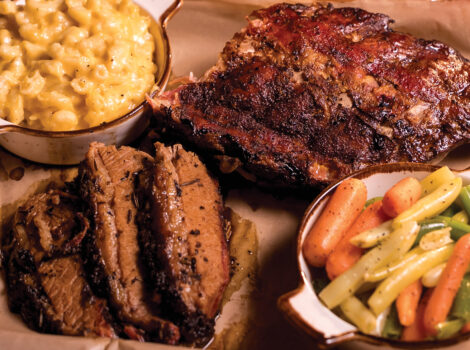
Another do-not-miss is 401 Prime’s Mac & Cheese selection, with added ingredients such as bacon, black truffle (oil, butter and shavings) and crabmeat.
Last, but not least, is dessert, which features everything from cookies, cheesecake and crème brulé to chocolate butterscotch bread pudding.
Such a dinner calls for complementary beverages and the menu beckons with classic cocktails, signature espresso martinis, an extensive wine list and zero-alcohol drinks.
401 North Prince Street, Lancaster
Hours: Monday-Thursday, 4-11 p.m. (kitchen closes at 9 p.m.) and Friday-Saturday, 4 p.m.- 12 a.m. (kitchen closes at 10 p.m.). Happy Hour is held Monday-Saturday, 4-6 p.m. and 8-10 p.m.
Information: 401primelancaster.com
Wagyu
Mention beef and the word “wagyu” will probably come to mind, as it seems to be the foodie buzzword these days. Wagyu translates as “Japanese cow.” It’s become the crème de la crème of beef, even boasting a program through which chefs and other industry professionals can gain an in-depth appreciation for wagyu’s very existence. To earn that distinction – officially known as a Sommelier of Wagyu – one must attend a butchering school, visit a wagyu farm and present two butchering demonstrations, including one at the Japanese embassy in Washington.
What’s so special about wagyu? In Japan, four genetically distinct breeds produce intramuscular fat marbling, creating meat that exhibits a buttery texture and rich flavor, thus producing the melt-in-your-mouth taste sensation that beef lovers crave. The meat is so rich in flavor that wagyu is best consumed in small portions (3-4 ounces).
Wagyu breeds include Kuroge Washu, a black cow that is the most common and produces the highest degree of marbling. Another is Akage Washu, a red-brown cow whose meat possesses less fat but provides a beefier flavor. The third breed is Nihon Tankaku Washu, a shorthorn cow primarily raised in Northern Japan and whose meat delivers moderate marbling and a rich taste. The fourth breed is Mukaku Washu, a rare black hornless cow (only 200 exist, making it an endangered breed) that produces a leaner meat with intense flavor. The lineage of the breeds is tracked through a national registration system.
Breeding for quality and not quantity began to emerge in Japan in the mid-1800s. Today, there are thousands of farms that raise wagyu, with the max size of a herd being 50 to 60 cows. The cows don’t graze. Instead, their controlled diets are primarily composed of grains. They also stay in the barns most of the day, where music adds to the calm atmoshere. Why such small herds? The sale of one cow can command as much as $30,000.
Australia has the largest herd outside of Japan. It’s composed of both full-blooded and crossbreeds of wagyu.
The United States continues to play catch-up. Fifty years ago, the first wagyu cows arrived in the U.S., along with four bulls (two Kuroge and two Akage washus). Twenty years later, Japan declared the wagyu cows a national treasure and banned their export. Ranchers resorted to breeding the wagyu with American stock (primarily Angus). As a result, it is estimated that only a small percentage (16%) of the “wagyu” cows that exist in the U.S. can be considered full-blooded wagyu. However, the United States Department of Agriculture (USDA) has its own standards and considers a cow whose lineage is at least 50% wagyu and 50% Angus to be deemed “American wagyu.”
Historical Tidbits
Ah, the hamburger. It’s synonymous with America. Nearly 50 billion burgers are sold each year in the U.S., and who knows how many are prepared on backyard grills in that timeframe. But it seems the lineage of the hamburger can be traced to Germany, notably Hamburg, which was an important trade center during the 12th century and where beef dishes were popular.
Fast forward to the 19th century, when political upheaval prompted a German migration to America. Here, German-trained butchers advertised Hamburg-style chopped steak as a specialty in their shops. At the same time, raw beef that was chopped, chipped or ground was being touted as solution for digestive issues. However, a New York City doctor, James Salisbury, suggested cooked beef might provide a better solution, hence the introduction of Salisbury steak, which led the way to beef patties.
As for the hamburger as we know it, a wide range of diners, restaurants and fair vendors have laid claim to its “invention.” One name that keeps popping up is Louis Lassen, who operated Louis’ Lunch in New Haven, Connecticut. As the story goes, in 1900 a customer came in, told Lassen he was in a hurry and asked him to make something he could take along. Lassen placed a beef patty between two slices of bread and the customer was out the door in a snap.
As for the modern-day bun, credit for that goes to Walter Anderson and Fred Chapman of Wichita, Kansas. Anderson, a cook in a diner, grew frustrated by how bread fell apart when used for hamburgers. He and Chapman designed a mold to shape dough into a bun and the problem was solved.
According to History.com, the opening of White Castle in Kansas made burgers a phenomenon. Founded by Billy Ingram with $700 in 1921, White Castle is credited with creating many of the fast-food industry’s innovations, including their signature slider-sized burgers, which Time magazine declared to be “the most influential burger of all time” in 2014. White Castle also introduced concepts such as coupons, take-out and partnerships with groceries. They’ve stayed current by rolling out food trucks and apps.
As for steak, the word is thought to be derived from a Nordic one, “steik,” which translates as “meat-on-a-stick.” The domestication of cattle dates back 10,000 years ago in Mesopotamia.
How popular is steak in America? According to the USDA, Americans consume 17 to 20 billion pounds per year (overall, beef consumption is estimated to be 28 to 30 billion pounds).
At one time, access to beef was limited to the areas in which cattle ranches were located, namely Texas, the Midwest and the western U.S., where the citizenry could enjoy steaks at chophouses. Such eateries were casual affairs, in that no menus were offered, and diners simply ate what the cook felt like making that day.
It wasn’t until the railroads stretched coast-to-coast that cattle could be shipped east. And Easterners welcomed beef with gusto. In the early 1900s, Beefsteak Banquets became all the rage in cities like New York, where they became synonymous with political fundraisers. Limited to male guests, the banquets were rowdy affairs, with gluttony being the theme of the night, as guests helped themselves to mounds of meat and bread (and, no doubt, alcohol).
Steak also came to epitomize fine dining thanks to the steakhouses that appealed to society’s upper crust. Delmonico’s, which opened in New York in 1837, is considered to be the trend setter, as it became the place to celebrate momentous occasions or close business deals. Women were welcome to dine at Delmonico’s and other fine-dining establishments.
Steak continues to enjoy an allure that no other cut of meat has attained. It’s still the go-to choice for special occasions. It remains the dish that tempts us to splurge when dining out. It’s also the weekend treat that can be cooked on the backyard grill and savored.